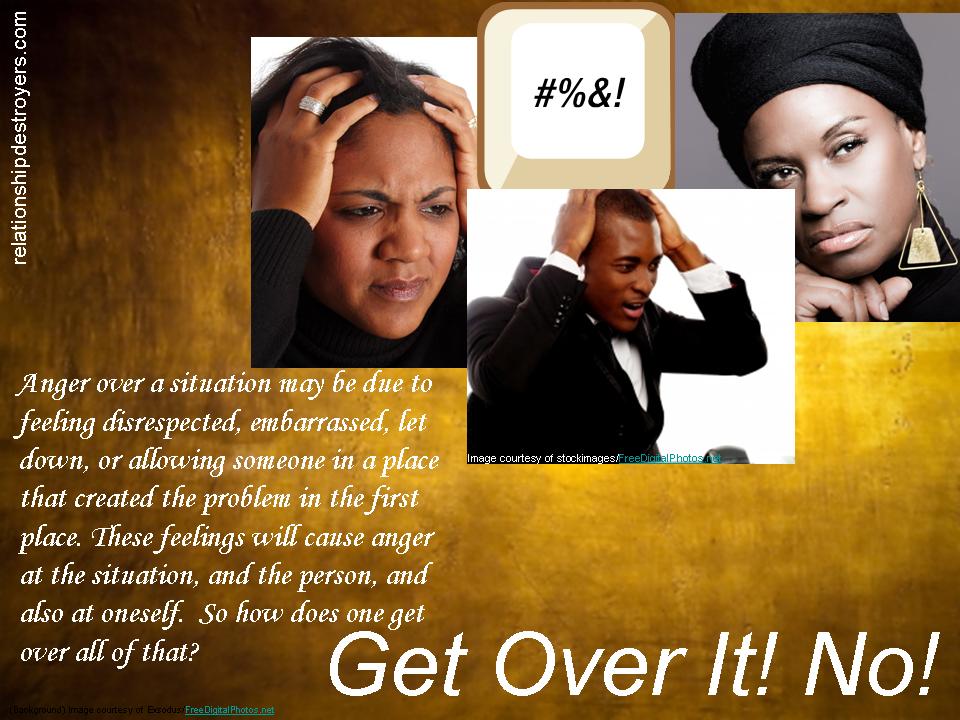
Get Over It? No!

Get Over It - No 2

There are no words more annoying than telling someone to ‘Get over it’.

In saying this, the words imply no empathy, no compassion, indifference, waste of time, emotional desertion, and down right insensitivity.

Many folk just can’t ‘get over it’. Depression exists, because someone can’t get over their devaluation of self; suicide exists, because someone can’t get over ending it all; and narcissism exists, because some person can’t get over him/herself.

Anger over a situation may be due to feeling disrespected, embarrassed, let down, or allowing someone in a place that created the problem in the first place. These feelings will cause anger at the situation, at the person, and also at oneself.  So how does one get over all of that?

Try understanding the root of the problem.  It is the hurt.  And if there is hurt, a level of vulnerability is impacted too.  When we allow someone to hurt us, by the gesture of letting them in, we give them entry to a private place where many people are not allowed.  Allowing that person “in” comes with a spoken or unspoken understanding, trust, and safety in a “you will not cause me pain” zone. And that trust is not given as freely as we would offer a glass of water.

So, we are battling with all of these feelings and to add insult to injury, the feelings of disappointment has left us helpless, because we gave away our trust, in hopes of that trust not being violated. But not only was it violated— it was raped and breached.

So, the next step is to talk about it. And the last thing we need to hear are the words, ‘Get over it’.

Getting over it takes some thought and pure objectivity. Putting the feelings to the side is the only way to think this through. If not, our feelings will speak for us, to us, while defending us.  Thinking is not easy to do.

But it must be done, if we are truly interested in emotional healing and sealing up our vulnerability so we will not be impacted as much next time, as we were this time.  This is the way to building emotional strength.

So, we think why did it happen? Was there anything we may have done— besides letting that person in? Did we take it like a victim and were we indeed the victim?  Or did we say or do something that brought a repercussion in which we could not retaliate.

If we were the victim, why? Did we allow access to a vulnerable place to a person who did not deserve it? If so, okay. We own it.  No more of that. That shit is over.  What will we do next time in order to not be a victim this way again? We will identify the signs of the same situation shaping up again, and we will have a different response and reaction.  It’s like rewinding the situation again, to get a different result.  We will handle it differently next time.

Was ill-intent the motive of the person involved? Our instincts will objectively give us a play-by-play of the situation giving us clues we missed during the exchange. If there was no ill-intent involved, we go and rectify the situation by addressing the situation, and how it could have been handled differently.  If ill-intent was the motive then what else could there be, but a selfish emotion of the person involved. If that is the case, we cannot remedy that.  We chalk it up to resentment or jealousy and move forward. Because we know haters love to hate.  Someone’s debilitating hatefulness has nothing to do with us. So we move forward with a smirk.

So, the next time someone decides to say “Get over it” there will be some thought and understanding of what is really going on. Rather than blow off the concerns, why not listen, and provide support.

We will eventually get over it, when we have worked it through, and are fully equipped to do it, not simply because we were told to do it.

Posted in Emotions | Tagged , , , , | 1 Comment

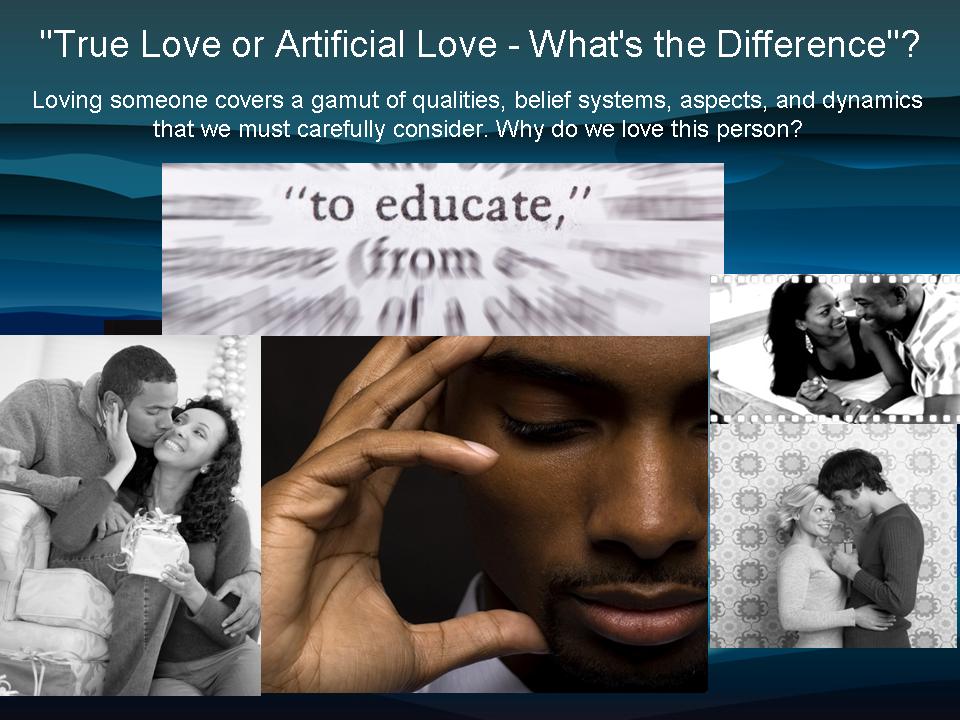
“True Love or Artificial Love – What’s the Difference”?

Love what difference2

I was on The Female Solution talk radio show, http://www.blogtalkradio.com/the-female-solution hosted by Sister Naimah Latif. The subject was “True Love or Artificial Love – What’s the Difference”?

It would help to have these discussions often, all over the world, because folk are giving up on Love, being damaged, deceived, emotionally and intimately beaten down—all in the name of Love— or what they believe to be Love.

I would argue, that artificial Love does not exist. We call it this, because it is the opposite of Love.    Love can only be authentic.  Any adjective that means anything other than genuine, or true, is simply false.  Love is the real article.

There are, however, deviations of Love.

Simulation is a behavior and demeanor a person uses that only appears to be Love.  This person either has an agenda or has been programmed to do what is right to do.  Either way, they appear to love you, but in their heart,  the Love is not there.  They appear nearly perfect in all the demonstrations of what love should look like, but you, as the recipient of that demonstration, will feel empty or feel something is missing. In the recesses of your heart you will question whether they are real or not.  Their kiss and touch is not arousing, and it leaves you with an empty feeling.  Your heart is not connecting with this person.

The person who simulates love like behavior, will appear to be the real article, but will lack autonomy, creativity, and the warmth necessary to provide intimacy.  Even the sex will be unfulfilling.

The person who simulates loving behavior may only be able to mislead someone who is desperate or vulnerable.  Anyone who can be overcome by a person with simulated Love behavior lacks self Love.  When you lack self love you can become a victim of loveless love.   So, the simulated kiss, may be the only passion a victim of loveless love may have known.  To one who has self love, he/she will find that same kiss to be void of passion.

Infatuation is the feeling most folk misconstrue as Love.  Their feelings about a person have them high on a cloud.  There is no specific timeline as to how long it will last, but it will fade over time.  One sign of infatuation is “falling” in love. Another is having sex and deciding after the orgasm, you are in love. Infatuation is primarily perpetuated by feeling— whether it is emotional or sexual.  Infatuation lacks depth and logic.  It is all about how a person makes him/her feel.  

The truth is, the more we react to Love with our feelings, the more we risk failure in the relationship.

The depth of Love that one person gives, is based on the depth of self Love one has for one self.  If there is a lack of self Love, it will eventually become clear in the relationship.

Our society is facing love-less disorders due to our treatment of each other.  We are saying the words, “I love you” everyday, but our actions are only a portrayal of what love looks like, yet we lack the genuine connection, involvement and responsibility of what Love is. This puts us so far from Love, and its beauty.

Loving someone covers a gamut of qualities, responsibilities, belief systems, aspects, and dynamics that we as a society must give great care and thought to.  Why do we love this person?  How deep can we connect with this person?  How does this person make us feel in the areas of our strengths and weaknesses?  Can this person mirror our love and how would we mirror theirs? What are the values we share  intellectually, emotionally, ethically, mentally, socially, historically, spiritually, sexually, romantically, financially and relationally? What are our commonalities?  How do we differ? Will those differences create a sever in the relationship?  Will our commonalities create boredom?  Can we trust this person with our heart?  Can we openly talk about everything regarding the relationship?  Will the relationship be worth our emotional investment?   Can we be of value to each other?  Will we continually grow as a couple?  What are the emotional strengths of this person?  How will that impact the relationship?  These thoughts cover a wide and balanced spectrum of what will impact the relationship. That impact will either build the relationship— or divide.  

Love is more than a feeling and a loose compelling emotion. It is a higher level of affection that is encompassed by feeling, but validated with responsibility and intelligence.

Enjoy the authentic journey of love.

Posted in Actions in Relationship | Tagged , , , | 3 Comments